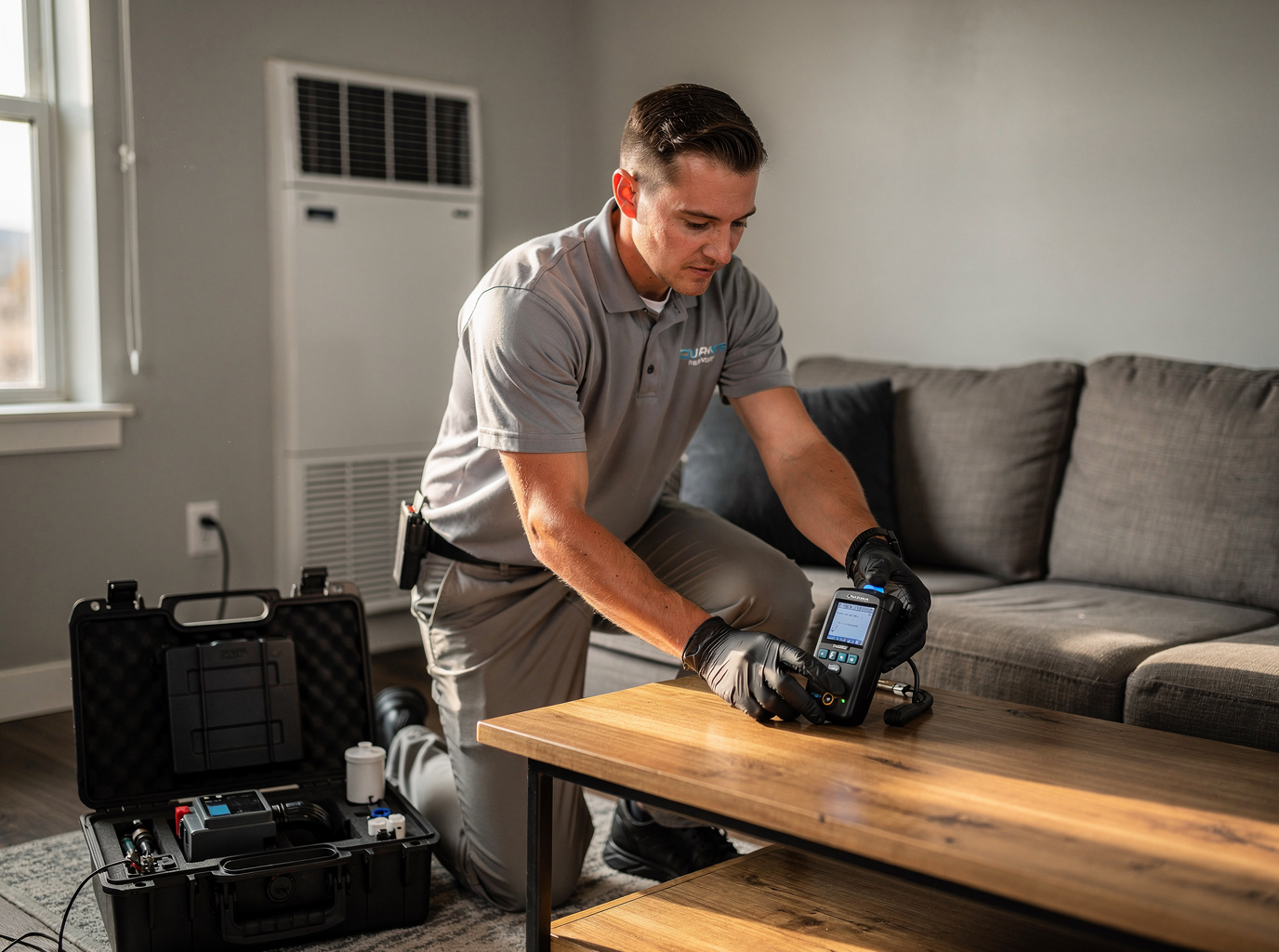
Indoor air in Elko doesn't behave like air in a humid coastal town. From roughly November through March, furnaces and water heaters run for hours while homes stay closed up against wind and snow, so combustion byproducts and stale air have fewer ways out. Summers flip the problem: hot, dry afternoons push air conditioners hard, and wind-blown dust settles into filters and ducts across Downtown Elko and South Elko. When regional wildfire smoke drifts into the Great Basin, fine particulates can linger for days, and a standard pleated filter catches only a fraction of them. Testing replaces guesswork with numbers, so you can tell whether your trouble is dust, moisture, combustion gases, or something you can't see or smell at all.
A useful indoor air assessment measures several things at once instead of relying on a single gadget. Carbon monoxide is the priority in any home with a gas furnace, water heater, range, or fireplace, and it should be read at the appliances and in sleeping areas during normal operation, not just in a tidy empty house. Relative humidity matters here because winter air outside is very dry, and indoor levels often swing low enough to irritate sinuses and skin, while homes with evaporative coolers can run too damp in spring. Carbon dioxide readings show whether ventilation is keeping up with occupants. Particle counts reveal dust and smoke load. Radon deserves a test in almost any home in Elko County, because the gas comes up through soil and foundation cracks regardless of how new the house is, and it cannot be detected by smell. Short-term consumer monitors are fine for spotting trends, but they are not a substitute for a lab-analyzed radon test or a proper combustion check.
Older houses around the downtown core and some rural properties in Elko County present their own quirks. Gravity-era furnaces and older masonry flues can be sized for appliances that no longer exist, and a single failing flue can push exhaust back into living spaces during cold snaps. Evaporative cooler setups, common across Nevada, add moisture to the house and can feed mold on attic sheathing and inside wall cavities if the home isn't vented properly. Crawlspaces are another common source of musty odor and humidity, especially where the vapor barrier is missing or torn. Be careful with fixes that look cheap on paper: sealing a house tight without adding controlled ventilation can trap pollutants and make them worse, and installing a higher-rated filter on an undersized blower can strain the system and reduce airflow. Always confirm the blower can handle the added resistance before upgrading filtration.
Once results are in, the sensible next step depends on what the numbers show. Elevated carbon monoxide means shutting down or repairing the offending appliance before anything else, and installing working CO alarms on every level and near sleeping areas is a standard recommendation. Radon above the EPA action level usually calls for a sub-slab depressurization system, which is a different job from ventilation work. Moisture and dust problems are often solved with a combination of better filtration, duct sealing, and a balanced fresh-air source such as an energy recovery ventilator. Pull a retest after changes, ideally in the same season, so you can confirm the fix rather than assume it worked. A good report should list each finding in plain language, the reading that triggered it, and the options ranked by cost and effect.
Technician insight
In Elko, the thing that catches most people out with indoor air quality is assuming a dry house is a clean house. Winter air outside is so dry that homes feel fine, while combustion gases and stale air build up behind tightly sealed doors and windows. If you run an evaporative cooler in spring, check attic and crawlspace moisture before you assume the air is healthy, because a damp framing cavity can cause more trouble than anything you're breathing in the living room.
Headaches in a Winter-Sealed Home
A homeowner in South Elko reported morning headaches and a stale smell during the coldest weeks, with the house closed up tight against wind. Testing at the furnace and water heater showed carbon monoxide rising during the morning heating cycle, and the flue draft was weak. The venting was cleaned and corrected, a CO alarm was installed near the sleeping area, and a follow-up reading confirmed levels had returned to normal.
Indoor Air Quality Testing Services We Offer
✓Carbon Monoxide Testing for Homes
Measures combustion gases at furnaces, water heaters, ranges and fireplaces while the equipment is running, so you know whether exhaust is venting safely. It is the most important check in any Elko home that burns gas or wood.
✓Radon Testing in Elko County Homes
Places a lab-analyzed radon test in the lowest livable level of the home for a reliable reading over several days. Radon is odorless and invisible, so this is the only way to know your level.
✓Humidity and Evaporative Cooler Moisture Checks
Tracks indoor humidity through winter dryness and summer cooler operation, then recommends ventilation or setting changes to avoid both dry air and damp conditions that feed mold.
✓Dust and Particulate Air Sampling
Counts fine particles from dust, smoke and other airborne debris, helping you decide whether better filtration or duct cleaning will actually make a measurable difference in your home.
✓Whole-Home Ventilation Assessment
Evaluates how well fresh air moves through a tightly built or sealed house, and whether an energy recovery or heat recovery ventilator would help without wasting heating or cooling.
✓Post-Wildfire Smoke Air Check
Assesses how smoke infiltration has affected your home after a regional fire season, and identifies filtration upgrades and sealing steps to reduce lingering particulates indoors.
✓Pre-Sale Indoor Air Assessment
Gives buyers and sellers a documented snapshot of air conditions, combustion safety and moisture levels before listing or closing, so there are no surprises for either side.
Indoor Air Quality Testing Cost in Elko, NV
| Service | Typical Range | What Affects It |
|---|---|---|
| Carbon monoxide and combustion appliance check | $100–$250 | Higher with multiple gas appliances, a wood stove, or a multi-level home needing flue inspection. |
| Radon test with lab analysis | $30–$150 | Varies with whether a passive kit or a longer continuous monitor is used, and with lab turnaround. |
| Whole-home humidity and particulate assessment | $150–$400 | Scope depends on square footage, number of monitoring points, and whether an evaporative cooler is included. |
| Ventilation upgrade following a test (ERV or HRV installed) | $1,500–$4,000 | Driven by unit size, ductwork access, and whether existing ducts need modification. |
Ranges are typical for Elko, NV and confirmed with an exact written quote before any work starts.
How it works
- 1
Walk-Through and Intake
We start by asking how the home is heated and cooled, what appliances burn fuel, whether there is an evaporative cooler, and what symptoms or odors prompted the call. We then look at the furnace, water heater, flue, attic, crawlspace and filter location to decide which tests will give useful answers.
- 2
Targeted Measurements
Readings are taken under normal operating conditions, meaning the furnace is running, the cooler is on if you use one, and doors and windows are in their everyday positions. Radon kits are placed for the standard test period and sent for lab analysis, while carbon monoxide, humidity and particle readings are logged on site.
- 3
Plain-Language Findings
You receive a written summary listing each measurement, what the number means in everyday terms, and whether it falls in a safe range. Anything that needs urgent attention, such as a venting problem, is flagged before we leave the property.
- 4
Options and Upfront Quotes
Fix options are ranked from simplest to most involved, with a quote given before any equipment is added. If you decide to hold off, the findings stay with you, and a retest can be scheduled once changes are made.
Pricing
Most indoor air assessments are priced as a flat diagnostic visit plus lab fees for radon, so you know the cost before testing begins. Costs rise when multiple appliances need combustion checks, the home is large or multi-level, or follow-up retesting is needed. We provide the quote upfront and do not add equipment without your approval.